
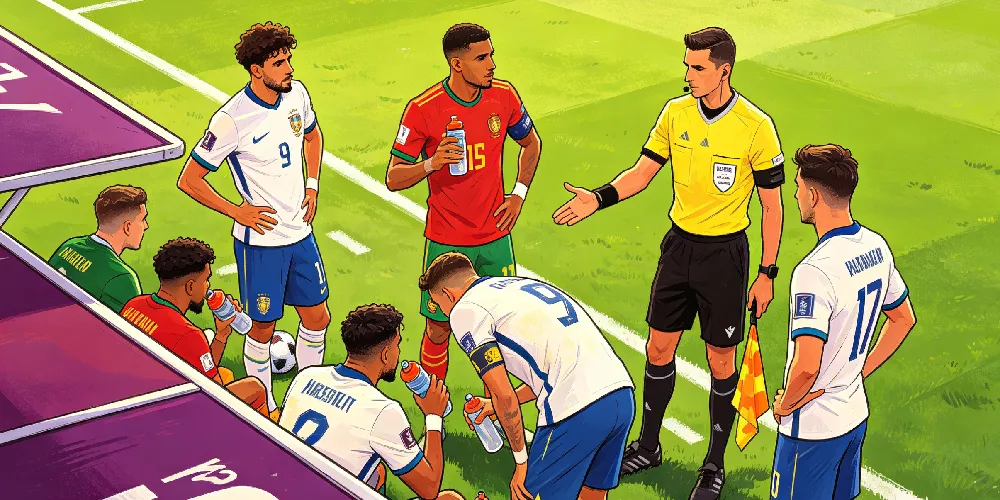

The FIFA World Cup 2026 will be played during the summer across the United States, Canada and Mexico, where several host cities are expected to experience high temperatures. To better protect the health of players and match officials, FIFA has introduced a standardized hydration break procedure for every match.
While fans often see hydration breaks as simply a chance for players to drink water, they are also an important part of match management. Referees must coordinate the timing, communicate with the officiating team, and ensure that play resumes smoothly and fairly.
What Is the FIFA World Cup 2026 Hydration Break?
Hydration breaks were first introduced by FIFA during the 2014 FIFA World Cup as a response to extreme heat. For the 2026 tournament, the procedure has been standardized across the competition to support player welfare throughout every match.
| Item | Procedure |
|---|---|
| Number of Breaks | One hydration break in each half. |
| Timing | Approximately the 22nd minute of each half. |
| Duration | 3 minutes. |
| Match Clock | The match clock continues running during the break. |
| Added Time | The referee adds the hydration break time at the end of each half. |
| Special Situations | If an injury stoppage occurs close to the scheduled break, the referee may slightly adjust the timing. |
How Should Referees Manage the Hydration Break?
Although the break lasts only three minutes, the referee crew has several important responsibilities before, during and after the stoppage.
1. Choose an Appropriate Stoppage
When the scheduled hydration break approaches, referees should avoid stopping play during an obvious attacking opportunity whenever possible. Instead, the break should begin at the next neutral stoppage, such as a goal kick, throw-in or free kick, helping maintain fairness for both teams.
2. Clearly Signal the Break
The referee should whistle firmly and clearly indicate that the official hydration break has started. Clear signals prevent confusion among players, coaches and spectators.
3. Monitor Players and Technical Areas
Although play has stopped, the referee team continues working. Officials should observe player behaviour, substitutions, coaching staff and the technical areas to ensure the break remains orderly and no misconduct occurs.
4. Keep Accurate Time
The match clock continues to run during the hydration break. Referees should accurately record the full three-minute stoppage so the correct amount of additional time can be added before the half ends.
5. Stay Connected with the Referee Team
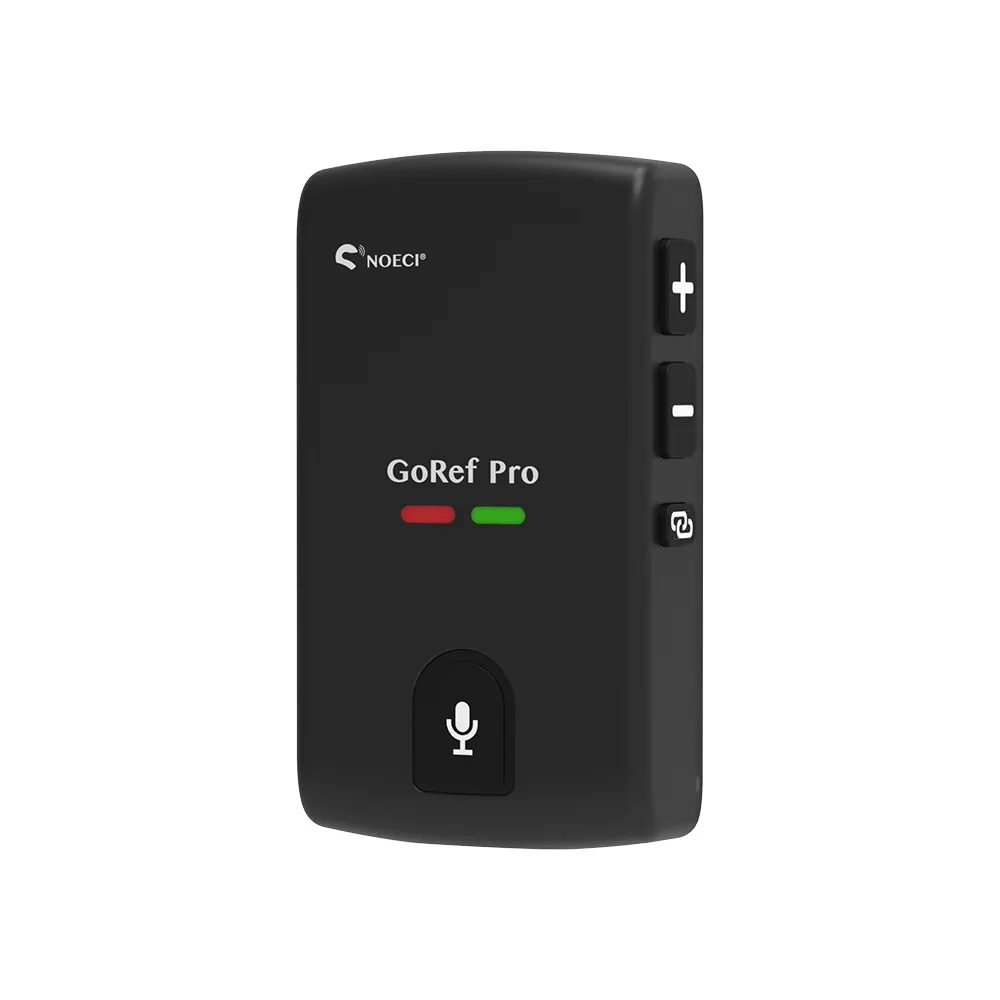
GoRef Pro Referee Headset
Built for referees who need longer range, stable group communication, and advanced features such as one-button audio recording and one-button mic mute.
- Bluetooth 5.4 for fast and stable wireless pairing
- One-button audio record with 512MB memory chip
- One-button mic mute for quick control during matches
- Clear and stable audio with noise reduction
- Up to 1500 meters communication distance
- Supports up to 6 users full-duplex group communication
Hydration breaks provide an opportunity for the referee crew to quickly exchange important information. Assistant referees and the fourth official can report incidents, confirm player management issues and prepare together for the restart.
Professional referee communication systems make this process much easier by allowing instant communication without shouting across the field.
6. Ensure a Smooth Restart
As the break comes to an end, referees should encourage players to return promptly and confirm that both teams are ready before restarting play. Efficient communication helps avoid unnecessary delays and keeps the match under control.
Why Hydration Breaks Benefit the Game
- Reduce the risk of dehydration and heat-related illness.
- Help players maintain physical performance in hot conditions.
- Allow referees to briefly recover and remain mentally focused.
- Improve overall match safety during long summer tournaments.
- Provide an organized pause without significantly disrupting the flow of the game.
Communication Is Just as Important as Hydration
During a hydration break, players naturally focus on recovering physically. For referees, however, those three minutes are also an opportunity to prepare for the next phase of the match.
Modern referee communication systems allow the referee, assistant referees and fourth official to coordinate positioning, discuss incidents and confirm the restart procedure instantly. This helps the entire officiating team restart the match confidently and consistently.
Final Thoughts
The FIFA World Cup 2026 hydration break is more than just a water break. It is a carefully managed procedure designed to protect player welfare while maintaining the fairness and rhythm of the game.
For referees, successful hydration break management depends on good timing, clear communication and effective teamwork. With proper preparation and reliable communication between officials, these short three-minute pauses can be handled smoothly while keeping the match under full control.
